The central goal of nuclear physics is to understand the structure and behavior of atomic nuclei. This pursuit began in the 1910s with Rutherford’s discovery of the nucleus, later understood to be composed of protons and neutrons. In the 1960s, electron–proton scattering experiments and the development of the quantum field theory of the strong interaction, Quantum Chromodynamics (QCD), established that nucleons are not elementary, but instead consist of three quarks bound by gluons. However, experiments soon showed that the properties of nucleons could not be explained by the three quarks alone. Instead, in addition to the three valence quarks, the nucleons contain a dynamic sea of quarks and gluons constantly interacting with each other. As of today, many fundamental questions remain: how are these sea quarks and gluons distributed in space and momentum, how do the properties of nucleons emerge from them, and what is the interplay between the elementary particles and the nuclear environment?
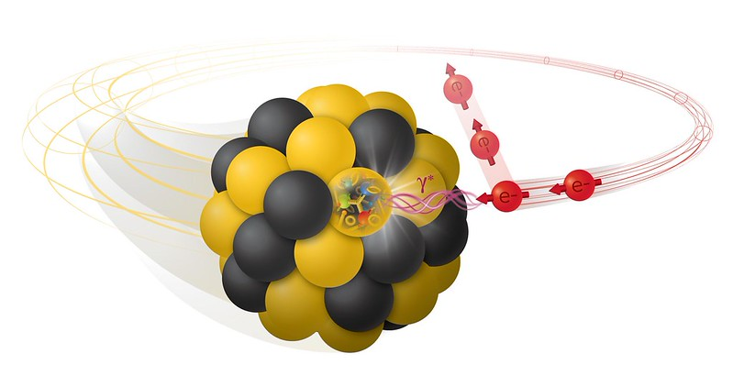
To address these questions, a new particle collider, the Electron-Ion Collider (EIC), is currently being built in the US. It will carry out deep inelastic scattering (DIS) experiments, where an electron collides with a proton or a nucleus, breaking it apart. The scattering is illustrated in Fig. 1. Measuring the remnants of these collisions provides insight into the structure of the nucleons. Compared to e.g. proton-proton collisions, DIS experiments are cleaner due to the electron being a point-like particle, providing a well-controlled probe of the nucleon. On the other hand, compared to previous DIS experiments, the EIC will have unprecedented experimental capabilities with its wider kinematic range, higher luminosity, and access to polarized heavy-ion beams. The EIC will start operating in the mid-2030s, marking the beginning of a new precision era for QCD measurements. At the same time, theoretical predictions need to be brought to a corresponding accuracy.
One central goal of the EIC is to probe the structure of nucleons at very high energies. Due to QCD interactions, the distributions of quarks and gluons inside nucleons are not constant but evolve under changes in energy. In particular, at high energies, the phase space for gluon emission increases, and the self-interactions between gluons lead to a rapid growth of the number of gluons in the nucleons. However, once so many gluons are packed inside a small region, they start to recombine, taming the growth of the gluon distribution. This phenomenon is called gluon saturation. Understanding this non-linear gluon-dominated regime of nuclear matter is necessary for a complete picture of nucleon structure. While gluon saturation is a necessary consequence of unitarity in quantum mechanics, it has not been verified experimentally. Indeed, this is expected to be very difficult: saturation cannot be confirmed from a single “smoking gun” experiment and must instead be inferred from subtle consistent patterns across multiple measurements. This demands excellent precision from both experiment and theory.
The theoretical calculations for DIS in the saturation regime factorize into two parts: the quantum evolution of the dilute probe particle, and its subsequent interaction with the dense nuclear target. While the target is a highly nonlinear system treated as a classical color field within an effective theory called the Color Glass Condensate, the evolution of the probe can be studied with perturbation theory. The idea of perturbative QCD is that, at high energy, the interactions between quarks and gluons are weak, and can thus be considered as small perturbations to the free theory. Including higher-order interactions systematically improves the precision of the approximation.
However, to gain access to the physical quantum states of quarks and gluons that then interact with the target nucleus, ordinary perturbation theory (that most QCD predictions for particle colliders are based on) becomes cumbersome. Instead, a more natural approach is so-called Light Cone Perturbation Theory (LCPT). In this approach, the particle dynamics are quantized and evolved with respect to a time coordinate defined along a light-like direction, i.e. a path that light travels. Instead of scattering amplitudes, in LCPT one computes light cone wave functions — probabilities for the original particle to fluctuate into a certain quantum state of quarks and gluons. The advantage of LCPT is that, unlike ordinary perturbation theory, only physical degrees of freedom are present. Unfortunately, this benefit of physical clarity is counteracted by calculational difficulties stemming from the breaking of spacetime Lorentz symmetry. Due to these challenges, high-precision results in LCPT have remained limited.
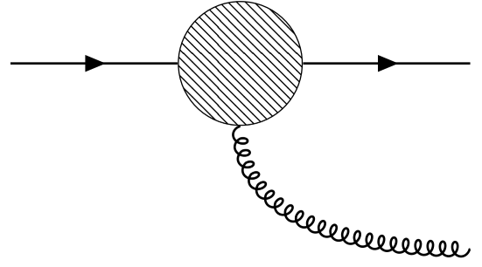
My master’s thesis concerned the development of precision calculations in LCPT. I computed the wave function for a certain elementary process, the emission of a single gluon from a quark, to next-to-leading order (or “one-loop level”) in the perturbative series, the current state-of-the-art precision in LCPT. A diagrammatic illustration of the process is given in Fig 2. The motivation for this calculation was threefold: First, as the wave functions are universal, computing this elementary wave function and understanding its structure will be useful for future calculations. Second, the calculation was performed by applying modern automation methodology to LCPT, paving the way for fully automated computations, which become essential at higher orders. Finally, the goal was to understand how the evolution of quark and gluon distributions can be derived from the wave function.
In the thesis, I successfully completed the calculation of the wave function and demonstrated how the evolution of quark and gluon distributions can be obtained beyond leading order. The results reproduced known expressions, providing important cross-checks of the calculation. Importantly, this approach avoids some of the technical difficulties and ambiguities present in traditional derivations of quark and gluon distribution evolution, highlighting the usefulness of LCPT. These results provide further insight into the structure of LCPT and its connection to the phenomenology of quark and gluon distributions. More broadly, this work is part of the effort to develop LCPT into a systematic and automatable framework for precision calculations. This may provide a standard approach for calculations in the non-linear gluon saturation regime of QCD, in anticipation of the upcoming EIC facility.
The full thesis can be found here: One-Loop Gluon Emission In Light Cone Perturbation Theory.